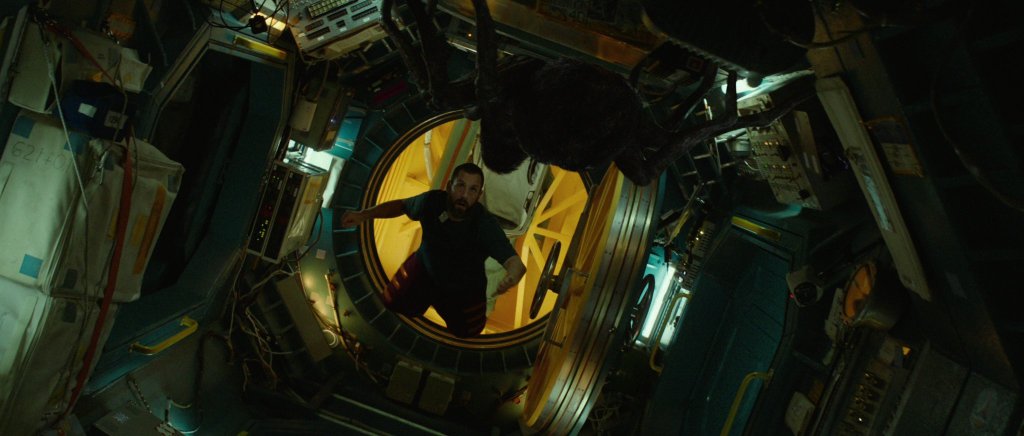
General Synopsis
Jakub, a Czech astronaut, is on a solo mission to collect a sample from a mysterious purple mist that appeared near Earth four years before. During this mission, his pregnant wife Lenka decides to leave him, which is kept from him by his care team on Earth. Not being able to communicate with his wife, he becomes more and more depressed. One day, he discovers that a giant spider shaped alien has been staying with him and studying him. They start talking, exploring Jakub’s memories and traumas, and Jakub names them Hanuš. They reach the mist, Jakub finds out Hanuš is dying and they both explore the mist, leading to Jakub starting to accept his trauma and move on from it. When he talks to Lenka, it implies a probable reconciliation upon his return to Earth.
Upon watching Spaceman, I logged into Letterboxd, as I usually do, hoping to see glowing reviews, a 3.4 to 4.0 rating average and some funny comments about the giant alien spider giving therapy sessions to a random Czech man. And, so, I was surprised to find it had a 3.0 and mostly jeering comments about how “men need to go to space and talk to an alien to find out they love their wife.” I went to cross-reference to Rotten Tomatoes, and found basically the same: 50% from the reviewers, 65% from the popular ratings and a general opinion of it being “too sad and philosophical”.
I won’t say I don’t understand these opinions. There is a history of women mostly being used for men’s development in stories without earning any personality traits other than “sad” and “wife”. There is even a name for it: the “Dead Wife” or “Disposible Woman” trope. And let us not forget the sadly necessary and still timely Bechdel Test, whose only requirement for passing is for there to be two or more women in a movie who have a conversation not concerning a man. And, on the other hand, the movie is slow and sad. However, I think there is more to this movie than this.
Disposable Woman
Whereas other stories may follow the same beats – unhappy marriage, miserable wife, husband learns his lesson, hopeful ending indicating probable reunion –, the wife in question has much more impact, personality and autonomy than what I myself expected.
1) Lenka decides to leave Jakub for very legitimate reasons. She is pregnant and alone, and is unable to trust Jakub, as he has shown no commitment to keeping his previous promises and is so focused on himself that he barely knows his wife.
2) Lenka has space to express some very complex feelings that are not solely focused on her marriage. Obviously, this story is mostly about the impact of unprocessed trauma on relationships, leading to lack of communication and, eventually, trust, and Lenka is shown mourning the marriage she thought she had and that could have been. However, she is also grappling with the responsibility of a child and having to think what’s best for them. Through her present decisions and the glimpses into Lenka and Jakub’s past memories, Lenka is shown to be adventurous, impulsive, caring, insecure, headstrong, intelligent and brave. She approached Jakub first, she took him on adventures, like choosing their future home or breaking and entering a pool and skinny dipping. She tried to help Jakub through his issues, talking to him and offering him a safe space, even though he made her feel small and unimportant. She decided to leave Jakub when she understood that he would not be a good enough father, placing her in a very fragile support situation. Still, she rectified this fragility and found her own support, even if it meant being “surrounded by strangers in a forest.”
3) Lenka is at the centre of the story. The reason the space trip is a problem is because Jakub is betraying Lenka. The reason Jakub is doing badly is the lack of contact with Lenka. The reason Hanuš becomes disillusioned with Jakub is them witnessing Jakub’s selfishness towards Lenka: he says he loves her, but leaves her alone as an act of self-punishment, and doesn’t notice it is also a punishment for her because he’s so blinded by his own feelings of inadequacy. The reason Jakub wants to become a better person and overcome his trauma and trauma-related shortcomings is for a second chance with Lenka. And she is the one who has a say on the rekindling of their relationship: it isn’t the completion of the mission that shows “reliability” and they immediately get back together. In many movies, a couple is separated and, during an unlikely event that threatens their future, they reorganise their priorities, they remember what they loved about each other and, in the, just… get back together. Not saying this isn’t possible, however, it would make for poor storytelling in this case. The threat is Jakub and his decisions. Thus, the ‘adventure’ is him realising the harm he is causing, apologising and asking for a second chance. And, in the end, Jakub gets a hopeful ending, not an immediate reward for his ‘good behaviour’.
In sum, despite Spaceman being about a man and his struggles, Lenka does not appear to be a simple side prop only present for further characterisation of the male protagonist or as a symbol/trophy of his success. It even manages to pass the Bechdel test, as Commissioner Tůmová has a conversation about Lenka with another woman on a plane. In the end, yes, Jakub did have a terrifying giant spider-shaped alien psycho-analysing him and his memories instead of just talking to his wife or a therapist. However, not to remember he loved his wife, but to realise he deserves love and to not waste the love he already has. This movie isn’t a feminist breakthrough, but it seems to me to have done more than the bare minimum in terms of its treatment of the ‘wife character’. I mean, she is alive, has more than two lines and doesn’t downplay her emotions in order to go around her husband’s. The bar is low, sure, but it is important to continue raising it to ensure that it is no longer accepted to treat women like props.
Pitiful and Pretentious
Among the most common criticisms – not including the ‘going to space and becoming friends with an alien instead of talking to your wife’ ones – are that Spaceman is sad, slow, and pseudo-philosophical. But is it?
Firstly, this movie is indeed sad. It is. But, is that a bad thing? Is there a Hollywood/Oscars curse making movies only able to be sad if they are happy at the end or utterly miserable and depressing the whole way through? Is it that we feel entitled to happiness because we cannot handle a sad movie? I don’t know. Either way, I disagree that this is an acceptable criticism, it is simply a characteristic. And this movie couldn’t be anything else. It deals with deeply hurt people reconciling with their past mistakes and the processing of trauma. This isn’t an all-encompassing portrayal, it’s a quick look into the possible consequences of these mistakes and what it could take to start solving them. I describe the ending as hopeful and not happy because Lenka and Jakub are still hurt; they are not over the finish line, they just started the marathon but can envision its end.
In terms of the film’s pacing, it’s, again, a characteristic. The story mostly occurs in space, a literal vacuum, and its main characters are a depressed man losing his wife, an alien that lost their planet and a woman that has lost trust in her partner and their marriage. From setting to theme, this story is about literal loneliness. Part of being lonely is the staticity, the lack of change, the bleeding of days into each other, a complete unawareness of time. In terms of practical story-telling, the slow pace of the movie attempts to convey what Jakub, directly, and Lenka, indirectly, are feeling, as they don’t have the luxury of 2x speeding through his mission, or skipping to the end. This type of story cannot be shown through the usual ‘necessary for the plot’ scenes, the plot is psychological evolution.
Finally, I believe Spaceman beautifully delivers its main point, one with merit and worth discussing: the universe doesn’t keep score, we do. This way, while we don’t owe anyone anything, as there is no metaphysical-quantum-astronomical bill to pay, our actions do impact others, and they also don’t owe us anything. So, Jakub doesn’t have to tell Lenka anything; however, he doesn’t because of a perceived debt to his father, who has died and has no bearing in the present, and Lenka doesn’t have to stick around on the sidelines watching his foolhardy attempt to settle it.
Sometimes, the best way to take stock of your life and choices is through distance from the normal and through the eyes of someone with a completely different mindset. Once Jakub is able to see just how much nothing matters to the universe, no scores to settle, no sins to absolve, and everything matters to the ones you love, how you treat them, he is able to see that he is simply holding himself back for no reason. Once he meets someone who has actually lost everything with no chance, way, or power to bring it back, he is forced to see that he does have the power to change things, he was just surrendering it to pain of the past. Nothing is permanent, since everything that has a beginning has an end, but what you do stays in the minds of those around you.
I hope Hanuš is happy among the beginning 🙂
 Nityadil