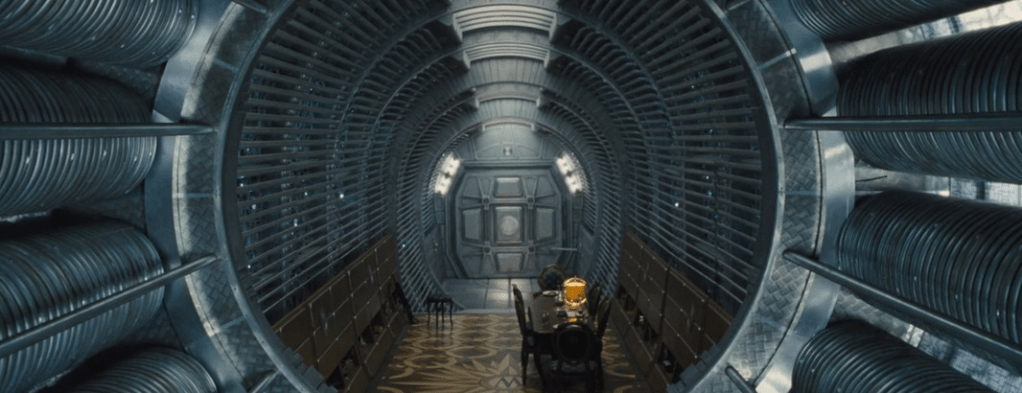
Snowpiercer explores, as many have pointed out, class inequality, oppression and human nature. However, there are some criticisms that I believe are/could be misplaced.
1. This wouldn’t be possible.
From what the movie informed us, Wilford had built this self-sustaining train that was made to withstand very high and very low temperatures, as its planned course included extreme temperature regions. I don’t believe that he actually predicted the global freezing, I think he, and all the people that made it to the train, were in the right place in the right time. And, as shown in the end, Wilford is more than happy to use people to continue the train: who knows, maybe he’s sent out some people to fix issues accounting for their inevitable death. And, just like Andy, they would be so influenced by his manipulation they wouldn’t even question it. Also, a lot of stories are set in impossible settings, like magic or sci-fi, but that doesn’t make the story less interesting or unable to offer allegory/comparison for real life. Most of these stories are exactly this.
2. Why would they keep the tail people?
If you want to keep people in line, it is important to create a mythology and indoctrinate the ones you lead: thus, Wilford the Merciful and Benevolent and the Divine Engine are created. This is further underlined by the hand motions that seem to be automatic for people when regurgitating the “keep in your place” propaganda. The way you control everyone is to oppress a group severely and inhumanely and use it as a threat of what could happen to the ones above if they fall out of line, just like in every empire. Just like the birds and the one stone, they save resources by not giving them to the tail people and this lack of resources is what psychologically keeps the system going. On the other hand, they can also use the tail people for manual labour that is needed but not desirable. And they have to keep the system going because it is what appears to be keeping everyone alive. If they were such a nuisance, the front would have already killed all of them and used them as fuel for something on the train. It is also my belief that people that weren’t able to pay for the train tickets aren’t “freeloaders”, they’re human beings who deserve dignity and survival and that, just like everyone on that train, were just trying to survive.
3. Why didn’t Curtis just take over the train and fix the inequality?
I believe this movie is trying to caution the people that plan to “fix it from the inside” that they are not immune to propaganda and that, in many cases, it is how the system is set up that is the problem, not the people who run it. This is exemplified by the ending. Only Namgoong cared that the snow was melting and bothered to check, so, clearly the ones in the front didn’t want to risk the end of a system that, right now, ensures their comfort. Curtis almost took the mantle of “conductor” by believing that he could fix the inequality himself, showing the power of propaganda over people, especially ones mentally suffering under oppression. But he discovers that, actually, the Divine Non-Stop Engine is neither divine nor non-stop and it relies on human exploitation — thus, the system is the problem. If it relies on human suffering, is it actually a good system? What would Curtis do, just accept that they would have to make 5 year-old children constantly be working in a dangerous situation forever? No, you have to tear it down, aka, stop the train.
CONCLUSION
In the end, I believe this movie defends several points:
1. People are not inherently greedy. In the beginning, all it took was for someone to sacrifice a part of himself for people to realise that what they were doing was wrong and only borne out of desperation and emotional disconnection and to stop; when Curtis was allowed to process what he’d done, he felt so guilty that it drove him to revolution. Not to suicide, not to revenge, but to lead a community effort to avoid anyone ever having to be sacrificed or having to know what people taste like. The front people are greedy because, just like today’s billionaires, they have so much and the tail people so little that the only way they can accept what is being done to the latter is to dehumanise themselves by following Wilford and his propaganda and to develop disdain for the ‘rightfully inferior’ tail people.
2. When a system is built like this, there is no way to fix it. Because there will always be someone that must be sacrificed to the engine, someone that will have to be exploited. Even if Curtis became the leader and started to share resources and work more fairly, this would still not fix the train. This would still be accepting the bounds of the society created by ones that built it on the backs of the exploited and that had no plans to change; even if there was possibility of survival outside these bounds.
3. A system built on violence can only be undone by violence. If any attempt for betterment is met with brutality and punishment and death, the only way to stop this retaliation is to make it impossible. That’s why revolutions are rarely a peaceful handover of power: the ones that have it don’t want to lose it and are willing to kill to keep it. People have to fight to live free or die fighting to free others.
TO FINISH
I am definitely missing some aspects, as I don’t know what to make of the whole Gilliam situation: was he really a traitor or was “cut out his tongue” a warning for Wilford’s powerful manipulation? However, I appreciated this movie and how it managed to represent in such a small scale our own society: basically impossible to rise the ranks, constant fear of dropping in the ranks, the exploitation of people when it is possible to feed and house everyone, and, becoming more pressing now, the climate change that is looming while we go in circles crashing against its consequences, holding on and hoping that it isn’t the rupture point when it all comes down.
 Nityadil